Time is the biggest return
The clearest saving is time. A few minutes spent searching for a tool on each job may feel trivial, but across a week it turns into hours — hours that could have gone into finished work. When every item has a fixed place, you are ready faster on site, you make fewer trips back to the van, and tidying up at the end of the day is quick. For anyone charging by the hour or trying to fit in one more job, that recovered time is the return that matters most, and it keeps paying back every working day rather than once.
A professional first impression
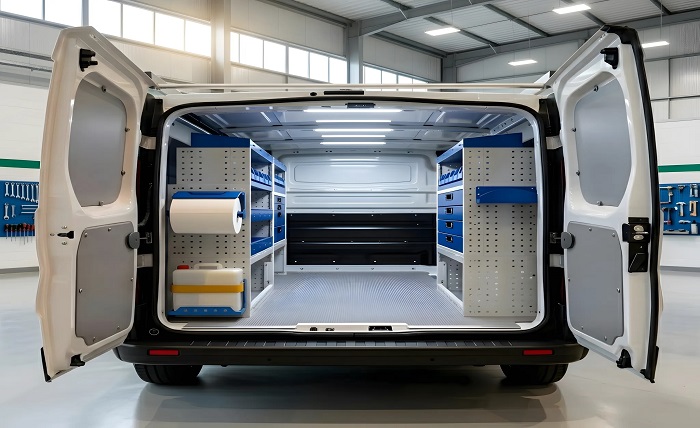
There is a softer benefit that customers notice straight away. When the back doors open onto a tidy, organised load area, it signals that the rest of the work is handled with the same care. A chaotic van gives the opposite impression, and first impressions are hard to undo. In trades where repeat work and recommendations drive the business, that quiet signal of professionalism can be worth more than it first appears.
Fewer losses, less damage
Loose tools knock about, go missing and wear out faster than they should. Giving each one a secure, fixed home means less is lost or damaged, and expensive kit is protected from the knocks of daily driving. Lockable cabinets can also help keep valuable tools safe and may deter theft, which is worth weighing up if the van is often parked on the street overnight. Over a year, fewer replacements add up to a real saving.
Built around your van
None of this works with a generic kit dropped into the back. The returns come when the layout is designed around the specific model and wheelbase, so the full length, width and height are used and nothing is wasted around the wheel arches. A system from a specialist such as Tecnolam is planned around how you work: a van racking setup where drawers, shelves and open space are matched to the trade, rather than a one-size-fits-all solution that leaves gaps and awkward corners.
Build quality, not just the material
How long the system lasts depends on how it is built. Steel (sheet steel) is a common choice for shelves, cabinets and drawers because it is strong and copes with heavy loads without developing play, but it is not the whole story: the design, the weight of the system, the stated load rating and how well it suits your model all matter. A floor panel, usually a hard-wearing board, gives a stable base to work and load on. A clever layout is of little use if the drawers start to stick after a year, so the construction and the rated capacity are worth asking about.
Safety that protects the business too
Load security is not only a legal and safety matter; an incident on the road costs time and money as well. Drawers fitted with transport locking, together with well-anchored shelves, help keep heavy items in place and form the basis of proper load security. It is an aspect that goes unnoticed on most days and matters exactly when it counts — and keeping it right protects both the driver and the running of the business.
An asset that can move with you
A solid racking system is better seen as an asset than a cost. Good materials help it last for years, and depending on the build and compatibility between models, a large part can sometimes be reused when you change van — worth checking case by case. Added to the daily time saved and the tools protected, that gives it a longer payback than many pieces of equipment that cost far more attention.
Before investing, it pays to think honestly about what the van carries each day and how that might change, then settle the layout with a specialist who knows the model. Seen as a whole — time recovered, tools protected, a professional impression and safer loads — a properly fitted van earns its keep in ways that rarely appear on a single invoice but show up clearly over the life of the vehicle.